
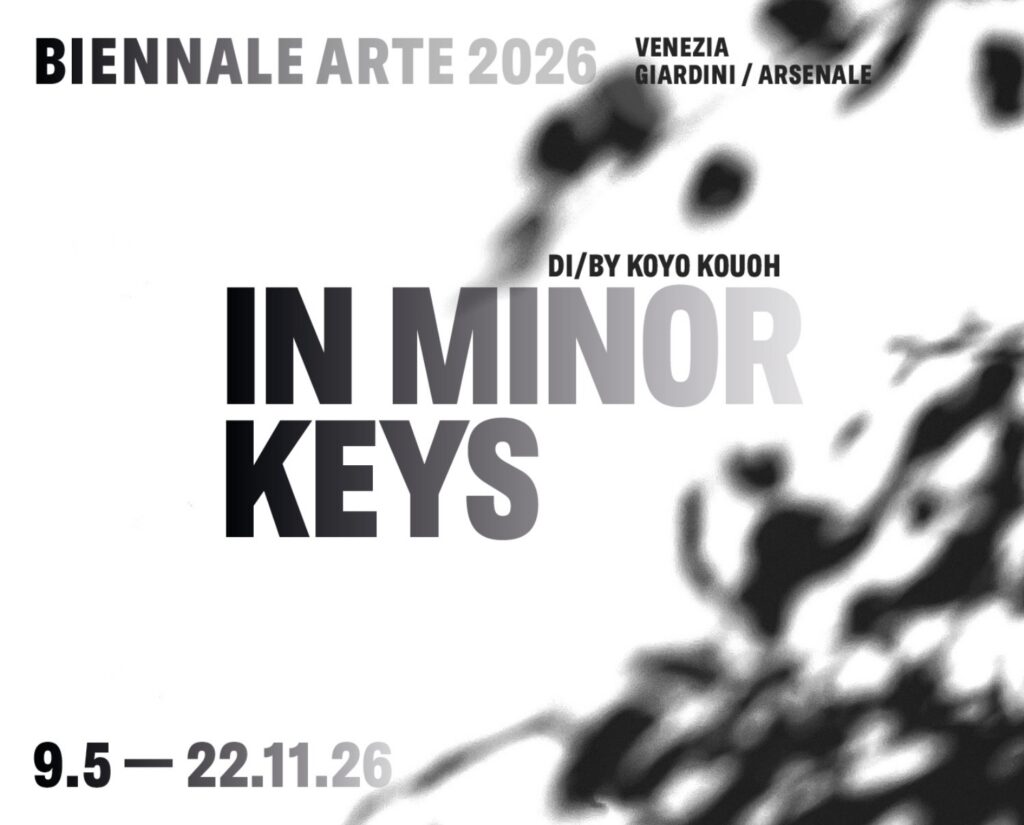
The 61st International Art Exhibition of La Biennale di Venezia, In Minor Keys by Koyo Kouoh will feature 111 invited participants—among them, individual artists, collaborative duos, collectives, and artist-led organisations*—from many different geographies and regions. Civitella congratulates Theo Eshetu (CRF 2002), Pauline Oliveros (CRF 2015), Kambui Olujimi (CRF 2015), Uriel Orlow (CRF 2016), and Berni Searle (CRF 2001) on their inclusion! Exhibitions take place at the Giardini, the Arsenale and in various locations around Venice, Italy from May 9th to November 22nd, 2026.
*Denniston Hill is one of the artist-led organizations invited to participate in In Minor Keys, and the installation, entitled CHIMERA, inspired by the Surrealist parlor game Exquisite Corpse, features several Civitellians: sonia louise davis (CRF 2019), Natalie Diaz (CRF 2015), Kambui Olujimi (CRF 2015), Shailja Patel (CRF 2023), and Brenda Shaughnessy (DG 2018).
Curatorial Approach
The President of La Biennale di Venezia Pietrangelo Buttafuoco commented on Koyo Kouoh’s curatorial approach:
It is an exhibition permeated with spirit, with a sacredness that puts the person, the human being, back at the heart of things, rediscovering the sense of being in the world by reacquiring a sense of proportion with respect to all earthly elements, and by looking to the sky once more. Koyo Kouoh’s journey is one that reappraises human relationships, starting from people’s own backyards. The little things, which are also great ones. The human dimension, the benchmark of everything, which a part of the world, yet one the most opulent and overdeveloped world – identified in the name ‘West’ – has long since lost sight of, misplaced. Thus, from the powerhouse of Africa, and from one of its leading voices, comes a whisper that leads us back to authenticity, acknowledging that the greatest happiness lies in the use of our own hands – a revelation that brings us back to the Earth, to our bodies and our senses. To a humility towards what is greater than us and what cannot be explained but merely intuited”.
This year’s artists were selected by Koyo with particular attention to resonances, affinity, and and possible convergences between practices, even when far apart. Koyo saw several conceptual motifs guiding the exhibition, which were determined through sifting from this reservoir of art: literary references, shrines, procession, schools, rest, and performances. They converge to form the In Minor Keys concept, developed by Kouoh before her passing in 2025, a “minor” approach—underscored by whispers, poetry, and quiet, sustained observation rather than “orchestral bombast” or, as she described it, “goose-step military marches”.
National Pavilions
Matias Duville‘s (CRF 2017) Monitor Yin Yang is a site-specific installation of Argentinian’s Pavilion opening on May 7th. The project transforms the pavilion into a traversable landscape constructed from salt and charcoal, expanding drawing—one of the central languages in Matias’ practice—into a spatial, sonic, and performative environment.
2026 incoming Visual Arts Fellow Beya Gille Gacha, who will be in residence later this summer, is a core contributor and the curator of Cameroon’s Pavilion. In addition to presenting a selection of her sculptures, she has curated the Pavilion’s exhibition “NZƏNDA“, which means “the door” or “the way home” in Medumba, a language of Cameroon. It is an immersive work in twelve chapters that transforms the entire space at Palazzo Canal into a journey across 400 square metres, working with sound, therapeutic waves, healing lights, medicinal plants, sculptures, video, and performative gestures to guide visitors through a process of reconnection with earth, body, heart, and spirit—a path toward healing and reconnecting with ancestors.
Gianni Moretti (CRF 2021) is part of Tanzania’s Pavilion with the exhibition Minor Frequencies: The Inner Life Of A Nation, together with a selection of international artists at Supernova (Cannaregio 3218/A – Fondamenta della Sensa) and Gervasuti Foundation (Palazzo Canova, Cannaregio 4998 – Calle Lunga, Santa Caterina, Il Campiello).
Farah Al Qasimi (CRF 2023) and Taus Makhacheva (CRF 2016) participate in Washwasha, a group exhibition presented by the United Arab Emirates’ Pavilion. Washwasha brings together six artists whose practices engage with contemporary soundscapes in the UAE, shaped by migration, transience, and long-standing ties to the land.
Tuguldur Yondonjamts (CRF 2015) is an exhibiting artist of the Mongolian Pavilion in the exhibition Entanglements: Connectivities Across Borders, delving into themes of interspecies relations, spirituality, and transnational exchange. Mapping histories of Eurasian diplomacy and trade, the presentation will further focus on the Mongol Empire’s connection to Venice during the 13th century.
Collateral Exhibitions
2026 Visual Arts Fellow Hera Büyüktașcıyan, who will be in residence later this summer, is featured in a group exhibition titled TURANDOT: To the Daughters of the East, a collateral event of the Biennale. Scheduled to run from May 9th to October 31st with a preview on May 6th, hosted at the ACP–Palazzo Franchetti. The exhibition is presented by Parasol unit foundation for contemporary art in collaboration with Fondazione Calarota, featuring video work, installations, sculpture, painting, spoken works, textile, and sound work from eleven female artists originating from Central Asia and the East. Thematically, TURANDOT delves into mythology and cultural heritage, offering contemporary perspectives on these subjects and reinforcing the Biennale’s tradition of expanding its curatorial scope through independent presentations.
Nalini Malani (CRF 2003) presents Of Woman Born, a site-specific exhibition at commissioned by the Kiran Nadar Museum of Art (KNMA). The immersive, nine-channel, 67-iPad animation chamber explores themes of violence, mythology, and the marginalization of women.
Learn more about the 61st Biennale at labiennale.org and plan your visit with our map & guide of Civitellians in Venice below!