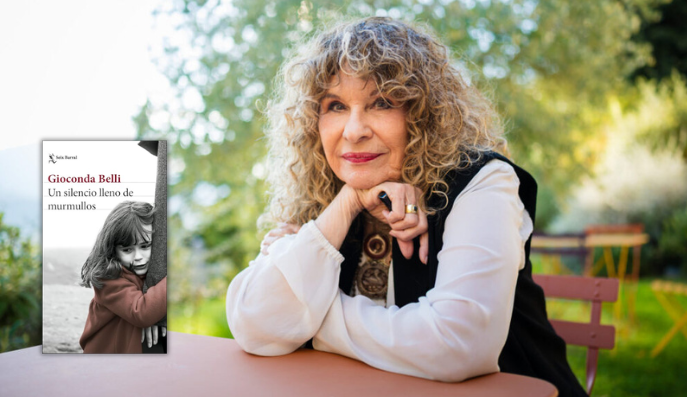
April 30th, 2026 — Gioconda Belli (CRF 2025) wrote to Civitella from Madrid, where she lives in exile, with news that shipment of her new novel, Un silencio lleno de murmullos (A Silence Full of Murmurs), was stopped by customs authorities in Nicaragua, her home country, on April 25th, 2026. Civitella joins PEN International in condemning this act and the larger trend of censorship, book banning, and the repression of people’s access to culture by the regime of Daniel Ortega and his wife and co-president, Rosario Murillo.
The dictatorial power fears the truths that literature illuminates. That is why they expel us, exile us, and imprison us. This happens and has happened to writers throughout history. —Gioconda Belli (CRF 2025)
Gioconda is a highly acclaimed Nicaraguan novelist, poet, and political activist. Celebrated globally for her revolutionary and feminist writing, and foundational contributions to Latin American literature, she has lived in exile in Spain after being stripped of her Nicaraguan citizenship in 2023 by the Ortega-Murillo regime. A former member of the Sandinista National Liberation Front, she fought to overthrow the Somoza dictatorship. She broke with the party in the 1990s and became a vocal critic of the Ortega-Murillo regime. She is the recipient of several prestigious awards including the 2025 Carlos Fuentes International Prize for Literary Creation in the Spanish Language, which she was awarded during her residency at Civitella.
“The dictatorial power fears the truths that literature illuminates. That is why they expel us, exile us, and imprison us. This happens and has happened to writers throughout history,” she wrote. The censorship of her work is the latest chapter in a systematic offensive that has disbanded 81 cultural institutions in the country and shut down festivals like the Granada International Poetry Festival, one of the most important literary events in the region, of which Gioconda was a member. In place, the regime has instituted an official state-designed cultural program that extends even beyond literature to cultural touchstones like beauty pageants.
While books by international authors are sold in bookstores, national authors like Gioconda are considered “traitors to the nation” and banned from the shelves. “They won’t be able to defeat people’s desire to read. There are many ways to read nowadays, without permission. I’m not happy that they’re preventing my novels from being published. But I am saddened that the Nicaraguan people are being prevented from reading their writers,” says Gioconda, born in a country with a robust literary and poetic tradition—Nicaraguans consider themselves “a country of poets”—of which she is one of the most prominent representatives.
Gioconda’s book tells the story of a guerrilla mother and her daughter, separated by the weight of political commitment and family secrets. The book is contextualized within the citizen protests of April 2018 which Ortega and Rosario Murillo violently suppressed, killing 350, imprisoning and exiling thousands, and were documented by the United Nations Group of Experts and the Inter-American Commission on Human Rights (IACHR) as crimes against humanity.
“Freedom of expression is under siege in my country,” Gioconda wrote over email. “From my exile in Madrid I am very saddened by these latest developments, but we shall overcome!!”
Gioconda’s courage and persistence to continue speaking, writing, and imagining a world beyond censorship are deeply meaningful for the writing community and freedom of expression itself. Her experience underscores the importance of spaces where artists can dream and create freely, and exchange ideas across borders without fear of oppression. Civitella is committed to continuing to create such a refuge where voices like Gioconda’s can continue to be heard.