
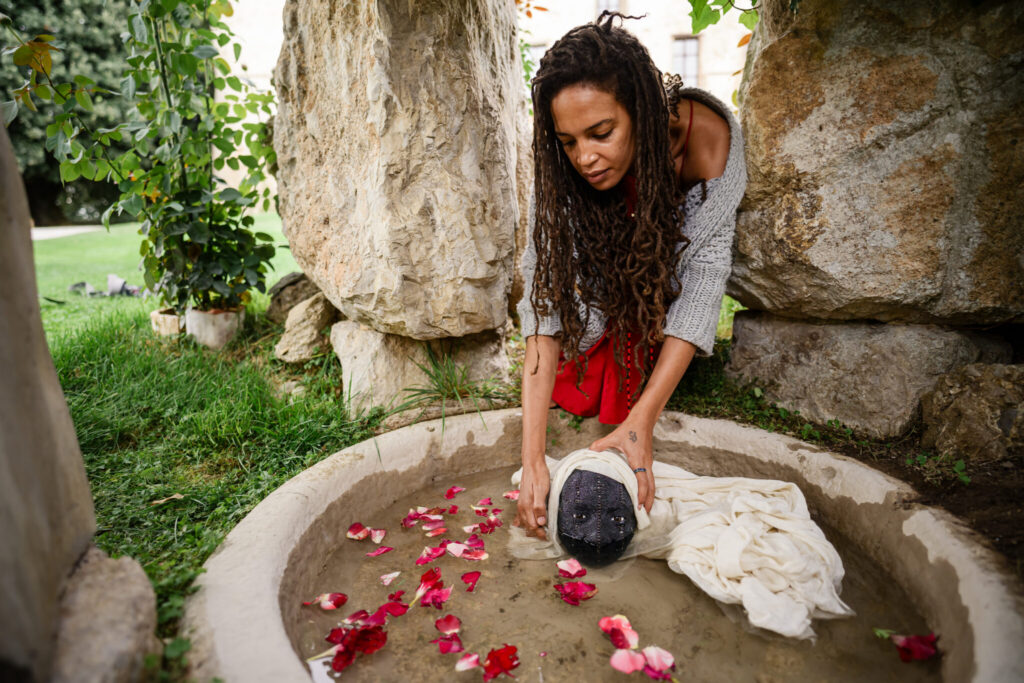
A new sculpture sits beneath the statue of Ruggero Cane, the patriarch of the Ranieri lineage, in the Civitella courtyard. An iteration of her piece Te Vejo at the 61st Venice Biennale, Visual Arts Fellow Beya Gille Gacha was compelled to install this version of Te Vejo at Civitella, across from her studio, Upupa, after receiving a sign from a wounded salamander at her studio door…
During her presentation at the Castle on TK, Beya brought the audience into her family’s history and connection to myth through her artistic practice. Similar to the Etruscans, the first people to settle on the land where Civitella’s stronghold now sits, Beya’s family considers “that events do not have meaning because they occur, but that they occur in order to have meaning,” as Residency Director Diego Mencaroni put it. She chose a few artworks to guide the story of her research and creative process, including the first Te Vejo sculpture created on Itaparica Island in Brazil, on view now at the Biennale. When she was making it, every morning there was a turtle outside her door. In her tradition in Cameroon, this is a very clear sign of a spiritual guide, synonymous with justice and a call to heal.
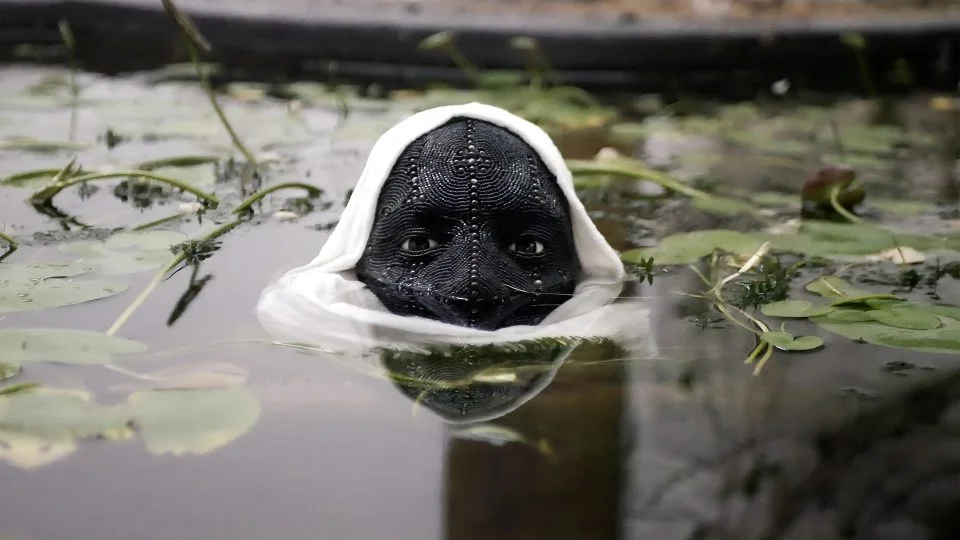
Part of the project was an exploration of how little magics like this can apply to more than a single artwork, and how one can share those magics collectively. And so Beya, finding herself receiving another message from the spiritual world, was called to reproduce Te Vejo at Civitella as she accepted the message that told her “heal” through this wounded salamander at her door. As she said in her presentation, “The art world is not all roses… I am still not ashamed to show up there with my true face.” In making Te Vejo, a beaded sculpture of her head, she finds herself, “finds her head” again, and in doing so, her connection with the spiritual worlds.
📸
1 – Photo by Marco Giugliarelli for Civitella Ranieri
2 – Detail of Te Vejo at the 61st Venice Biennale via labiennale.org.